
FPV versus camera drones: two different aircraft, two different disciplines
They both have four motors and a camera. Almost everything else — the control mode, the video path, the failure behavior and the legal footing — is different.
July 21, 2026 · 8 min read
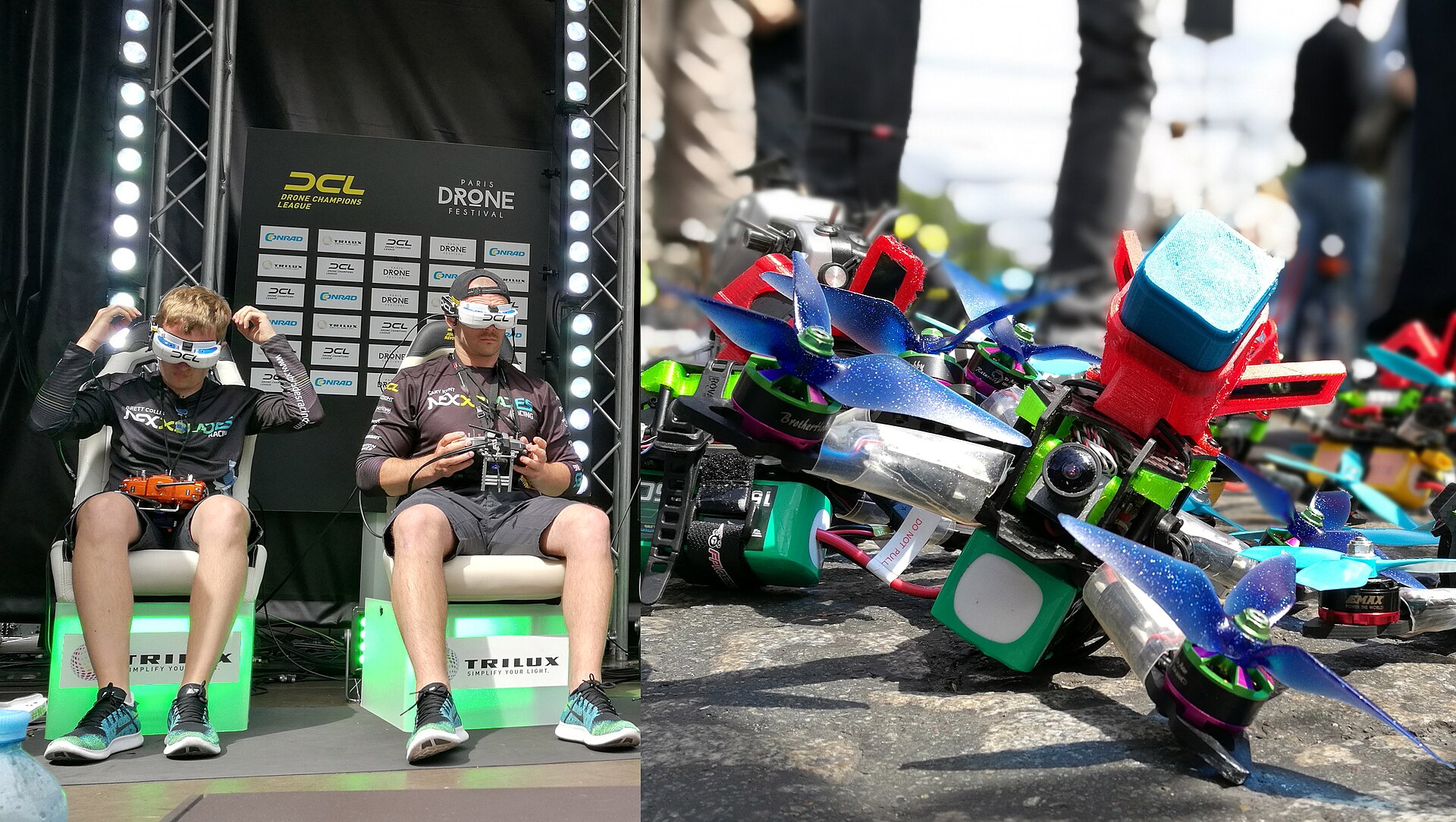
Newcomers often assume an FPV quad is just a faster camera drone. In practice the two are closer to different aircraft categories that happen to share a rotor count. Choosing between them is a decision about what you want to learn, not just what you want to buy.
How the pilot sees
A camera drone is flown by looking at the aircraft, with a phone or controller screen showing a stabilized, latency-tolerant preview. An FPV aircraft is flown through goggles fed by a live downlink from a camera on the nose. The pilot's whole frame of reference moves with the aircraft, which is what makes FPV feel like flying and also what makes it unforgiving.
- Camera drone: GPS position hold, altitude hold, obstacle sensors, return-to-home. Release the sticks and it stops.
- FPV: often flown in acro (rate) mode with no self-leveling at all. Release the sticks and it keeps whatever attitude you left it in.
- The FPV throttle typically does not spring back to center, because centered throttle would mean half power, not hover.
The video link is a separate radio system
This is the detail that surprises people most. An FPV aircraft runs two independent radio links: the control link between the transmitter and the receiver, and the video link between the video transmitter on the aircraft and the goggles. They can fail independently. You can lose video while still having full control, or lose control while still seeing a perfect picture.
Antennas matter accordingly. Omnidirectional antennas radiate broadly and are forgiving about aircraft orientation; directional patch antennas concentrate gain in one direction for range. Most goggles run both at once through a diversity receiver, which continuously selects whichever antenna is currently delivering the better signal.
Visual line of sight still applies
Goggles do not satisfy the visual-line-of-sight requirement. Under Part 107 the remote pilot must be able to see the aircraft with vision unaided by any device other than corrective lenses — and goggles are a device. The standard solution is a visual observer who maintains unaided sight of the aircraft and stays in direct communication with the pilot. Recreational operations under 49 U.S.C. 44809 carry a comparable visual-line-of-sight expectation.
Which one should you start with?
If the goal is usable aerial footage of a property, a job site or an event, a GPS-stabilized camera drone gets you there faster and safer. If the goal is to understand how a multirotor actually flies — and to be able to diagnose, repair and rebuild one — FPV teaches more, because nothing is hidden behind stabilization.
There is also a middle route we recommend to students: fly a simulator first. Simulator time costs nothing but electricity, crashes nothing but pride, and transfers remarkably well to a real aircraft in acro mode.
Primary sources
Everything above is drawn from these documents. Read them directly.
- 0114 CFR 107.31 — Visual line of sight aircraft operationU.S. Government Publishing Office / eCFR
- 0214 CFR 107.33 — Visual observerU.S. Government Publishing Office / eCFR
- 03Amateur Radio Service — licensing and operating rulesFederal Communications Commission
- 04Part 107 — Small Unmanned Aircraft Systems (rule overview)Federal Aviation Administration